Almost every student falls behind at some point. What matters is how quickly it’s noticed — and what happens next.
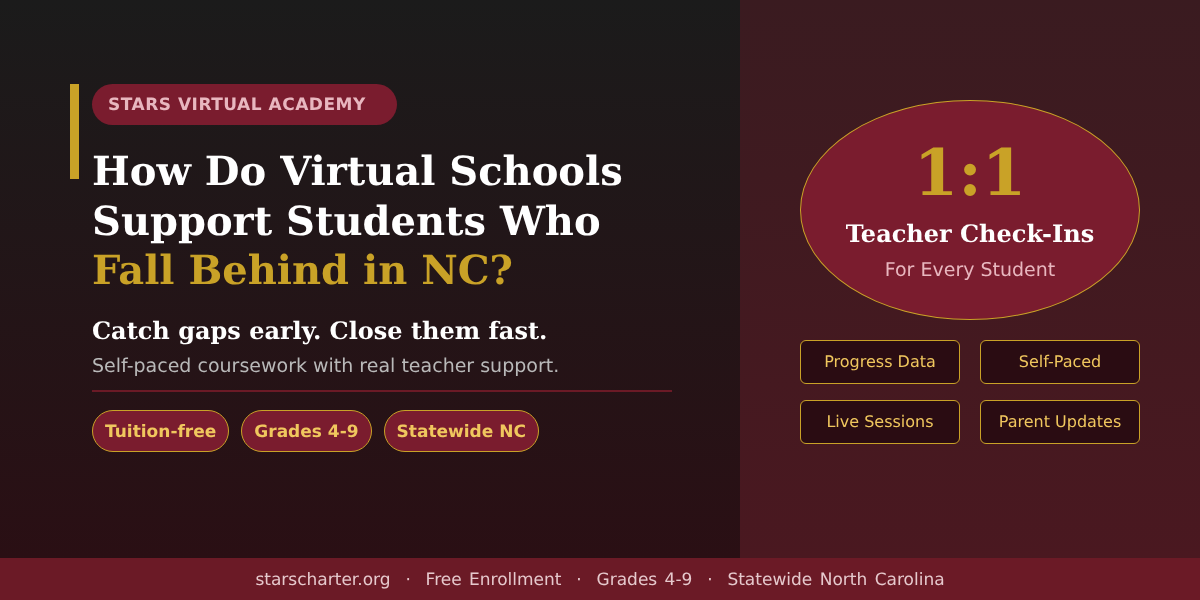
Virtual schools in NC support students who fall behind through progress monitoring, individual teacher attention, and self-paced coursework that lets students close gaps without being pushed ahead before they’re ready. At STARS Virtual Academy, a tuition-free North Carolina public charter school for grades 4–9, these supports are built into the everyday structure of the program.
Why Students Fall Behind in the First Place
Students fall behind for many reasons: a missed concept that later lessons build on, an illness or family disruption, a move between schools, attention or learning differences, or simply a class that moves faster than they can. In a large traditional classroom, these gaps can go unnoticed for weeks while the rest of the class moves on.
| At SVA, gaps are easier to see and easier to fix. Progress data and one-on-one check-ins mean a student who is slipping doesn’t get lost in the crowd. |
How SVA Identifies Students Who Are Falling Behind
- Real-time progress data. SVA’s Edmentum platform includes digital assessments and progress reports that show teachers — and parents — exactly where each student stands.
- Teacher progress monitoring. Certified teachers review each student’s work and results regularly rather than waiting for the end of a grading period.
- One-on-one check-ins. Individual conversations with each student surface problems that may not show up in scores alone.
- Parent visibility. Families have 24/7 access to progress, learning goals, and attendance dashboards, so they can raise concerns early too.
How SVA Helps Students Catch Up
Self-Paced Review
Because coursework is self-paced, a student who missed a concept can go back and work through it again before moving on. In a traditional classroom, the lesson only happens once; at SVA, the student can revisit it as many times as they need.
Individual Teacher Support
Through one-on-one check-ins, teachers can give struggling students more direct time — explaining concepts a different way, adjusting assignments, and checking understanding one-on-one. See how online students interact with teachers in NC.
A Plan Built with the Family
When a student falls behind, SVA teachers and parents work together on what comes next. Families know what’s expected, what support is available, and how progress will be tracked. Our post on parent involvement in online school explains the family’s role.
A Lower-Pressure Setting
Catching up can be discouraging when classmates are watching. Learning from home removes much of that social pressure, which helps students rebuild confidence along with skills.
How This Fits North Carolina’s Approach
North Carolina public schools use a Multi-Tiered System of Support (MTSS) framework to match support to each student’s needs. You can read more on the NC DPI Integrated Academic & Behavior Systems page. If your child’s difficulties are significant or ongoing, talk with SVA about whether an evaluation for additional services is appropriate.
Frequently Asked Questions
What happens if my child falls behind in virtual school?
At SVA, teachers use progress data and one-on-one check-ins to spot gaps early, then work with the student and family on a plan to catch up through self-paced review and individual support.
Can my child catch up faster in online school?
Many students do, because they can revisit material at their own pace and get more individual teacher time. Results depend on the student and on consistent effort at home.
How will I know if my child is falling behind?
SVA parents have 24/7 access to progress and attendance dashboards and hear directly from teachers.
Is online school a good option for a child who fell behind in traditional school?
It can be. See our guide to signs your child might thrive in online school.
What if my child is struggling right now?
See what parents should do if their child is struggling in virtual school in NC.
The Bottom Line
Falling behind is common; staying behind doesn’t have to be. STARS Virtual Academy combines real-time progress data, one-on-one teacher attention, and self-paced review so that gaps are caught early and closed with support — not left to grow.
| Ready to learn more? Contact STARS Virtual Academy at starscharter.org to ask questions and apply. SVA is tuition-free for students in grades 4–9 across North Carolina. |
Interested in flexible, tuition-free online school in North Carolina? Learn more about STARS Virtual Academy — serving students in grades 4–9 statewide.