The switch from traditional school to virtual school is a big change — but it doesn’t have to be disruptive. Here’s how to make the transition to STARS Virtual Academy smooth for your whole family.
Transitioning from traditional to virtual school in NC is a significant change for any family, but it’s one thousands of North Carolina families have made successfully. STARS Virtual Academy is a tuition-free North Carolina public charter school serving grades 4–9 statewide, and SVA’s onboarding process is designed to support families through that transition from day one.
Before the Switch: Setting Expectations
The most important thing families can do before transitioning to virtual school is set realistic expectations — for themselves and for their child. Virtual school is not easier than traditional school. It is different. The academic standards are the same. The work is real. What changes is the structure, the environment, and the pace.
Families who approach the transition with a clear-eyed understanding of what virtual school requires tend to have much smoother experiences than families who expect it to be simpler or less demanding than traditional school.
| Virtual school at SVA is not a shortcut. It is a different path to the same destination. Same NC state curriculum standards. Same certified teachers. Same academic accountability. Different structure, different environment, different pace. |
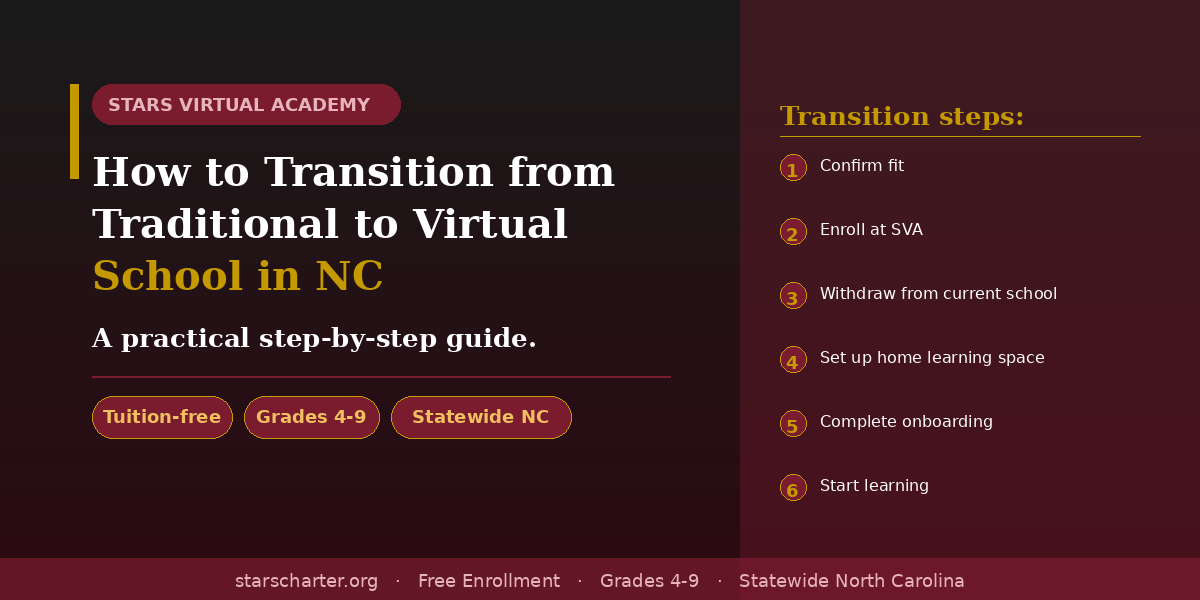
Step-by-Step: How to Transition to SVA
1. Confirm your child is a good fit — Before anything else, make sure virtual school aligns with your child’s learning style and your family’s situation. See our guide to signs your child might thrive in online school in NC for a detailed checklist.
2. Contact SVA and begin enrollment — Reach out to STARS Virtual Academy at starscharter.org to start the conversation. SVA staff can answer your questions, discuss your child’s specific situation, and walk you through the enrollment process. See our full guide to how enrollment works at STARS Charter School.
3. Withdraw from your child’s current school — Once your SVA enrollment is confirmed, formally withdraw your child from their current school. Contact your child’s current school office directly to understand their withdrawal process and obtain any records you’ll need for SVA enrollment.
4. Gather academic records — SVA will need your child’s prior academic records to confirm grade placement and understand their academic history. Request these from the current school during the withdrawal process.
5. Set up your home learning environment — Before your child’s first SVA school day, establish a dedicated learning space at home. This doesn’t need to be elaborate — consistent, quiet, and equipped with a device and internet access is what matters.
6. Complete SVA onboarding — SVA’s onboarding process introduces your family to the platform, the teachers, and the structure of the program. Take this seriously. The families who struggle most in the early weeks of virtual school are often those who rushed through onboarding.
7. Establish a daily routine before day one — Don’t wait until the first day of school to figure out the schedule. Work with your child in advance to establish a daily routine — when school starts, when breaks happen, when the school day ends. SVA’s flexibility works best when it’s built into a consistent structure, not left open-ended.
What to Expect in the First Few Weeks
The first few weeks of virtual school are an adjustment period for every family. Here’s what to expect:
There will be a learning curve
Your child will be learning a new platform, new routines, and a new way of engaging with teachers and coursework. This takes time. Most families find the adjustment period lasts two to four weeks before things feel natural.
Routine matters more than you think
The families who struggle most in the transition are often those who haven’t established a consistent daily routine. The flexibility of SVA’s schedule is an asset — but only if it’s given structure. A loose, undefined school day is harder to sustain than a consistent one.
Stay in close contact with teachers
In the early weeks, err on the side of more communication with SVA teachers, not less. If your child is struggling with the platform, falling behind on coursework, or having trouble adjusting, tell the teacher early. SVA teachers are equipped to support families through the transition — but they need to know what’s happening.
Your child may miss aspects of traditional school
This is normal and worth acknowledging honestly. The social environment of traditional school — hallways, lunch tables, team sports — is real, and some students miss it. Have honest conversations with your child about what they’re gaining and what they’re giving up. The transition is easier when those feelings are named, not ignored.
How Long Does the Transition Take?
Most families find that four to six weeks into SVA, the new routine feels normal. By the end of the first semester, the vast majority of students who were a genuine fit for virtual school have settled into a rhythm that works well for their family.
If the transition is still feeling difficult after six to eight weeks, contact SVA directly to discuss what additional support is available.
Frequently Asked Questions
How do I transition my child from traditional school to SVA?
Start by confirming SVA is the right fit, then contact SVA to begin enrollment, withdraw from the current school, set up a home learning environment, complete onboarding, and establish a daily routine before the first school day.
How long does the transition to virtual school take?
Most families find the adjustment period lasts two to four weeks. By the end of the first semester, most students who are a genuine fit for virtual school have settled into a comfortable routine.
Will my child fall behind academically during the transition?
SVA’s onboarding process and teacher support are designed to minimize academic disruption during the transition. Stay in close contact with teachers in the early weeks and flag any concerns early.
Is STARS Virtual Academy free?
Yes. SVA is a tuition-free North Carolina public charter school. There is no cost to enroll.
What grades does SVA serve?
SVA serves students in grades 4–9 across North Carolina.
How do I know if virtual school is right for my child?
See our guide to signs your child might thrive in online school in NC for a detailed checklist of indicators.
The Bottom Line
Transitioning from traditional to virtual school in NC is a real change that requires real preparation. Families who go in with clear expectations, a solid routine, and close communication with SVA teachers tend to have smooth, successful transitions. Families who treat it as a casual switch often struggle in the early weeks.
Do the preparation. Set the routine. Stay connected with teachers. The transition is worth it for the right student — and STARS Virtual Academy is built to support families through every step of it.
| Ready to make the switch? Contact STARS Virtual Academy at starscharter.org to start the conversation. Enrollment is limited to 100 students — apply early. |