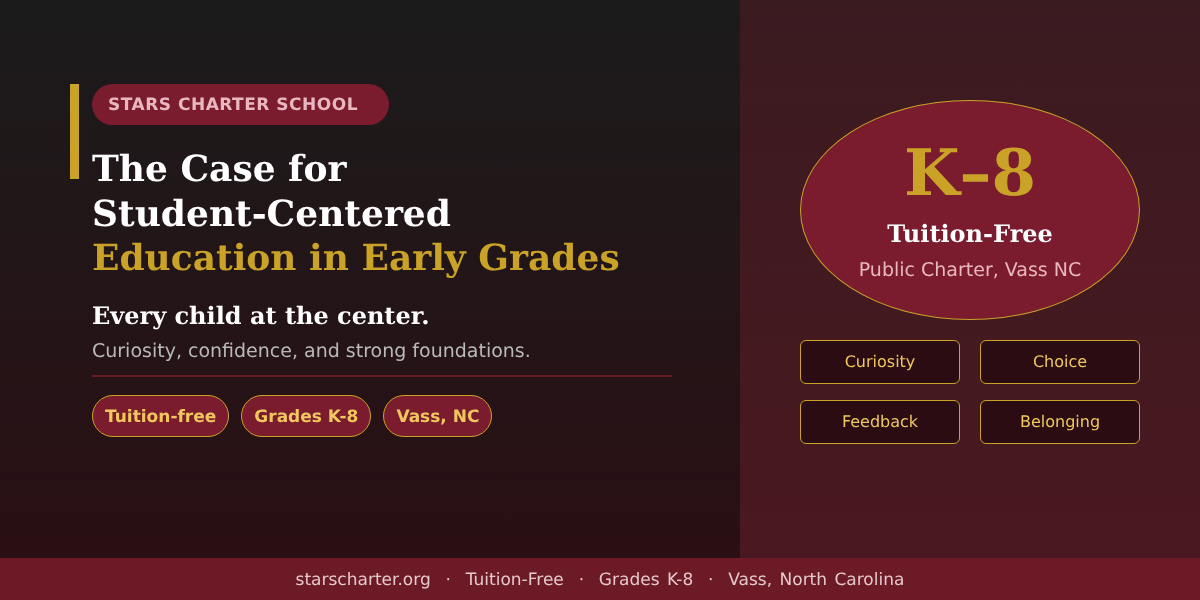
The early grades shape how children see themselves as learners. Student-centered education makes sure that picture is a confident one.
Student-centered education puts each child’s needs, interests, and growth at the center of teaching. In the early grades, that means teachers get to know each student, adjust instruction to where they are, give them real chances to explore and participate, and build a classroom where every child belongs. For North Carolina families, it’s an approach that works hand in hand with the academic standards in the NC Standard Course of Study.
What Student-Centered Education Looks Like
- Teachers know each child — their strengths, challenges, and interests
- Instruction meets students where they are — with extra support or extra challenge as needed
- Active learning — hands-on activities, discussion, projects, and the arts, not just listening
- Student voice and choice — chances to make decisions about how to learn and show learning
- Frequent feedback — so students know how they’re doing and what to work on next
- A sense of belonging — a classroom community where every child feels valued
| Student-centered doesn’t mean less rigor. It means holding every child to high standards — and giving each one the support they need to reach them. |
Why It Matters Most in the Early Grades
Foundations Are Being Built
Reading, math, and learning habits formed in kindergarten through the early elementary years shape everything that follows. Meeting each child where they are helps prevent early gaps from becoming long-term struggles. See how individualized instruction supports reading development.
Attitudes Toward Learning Form Early
Children who feel successful and curious in the early grades are more likely to stay engaged as school gets harder. Children who feel lost or invisible can start to believe they aren’t “good at school.”
Young Children Learn by Doing
Hands-on exploration, play, movement, music, and drama are natural ways young children learn. Student-centered classrooms make room for them.
Every Child Develops Differently
Some children read early; others take off later. Some sit still easily; others need to move. A student-centered approach respects those differences while keeping every child moving forward.
What to Look for in an Early-Grades Classroom
- Do teachers talk about your child as an individual?
- Are students actively doing, building, discussing, and creating?
- How does the school support children who need more help — or more challenge?
- How often will you hear about your child’s progress?
- Do the arts have a real place in the school day?
For more, see how to choose the right school for your child in NC and how smaller class sizes benefit elementary students.
Student-Centered Learning at STARS
STARS Charter School is a tuition-free K–8 public charter school in Vass, NC, with a focus on the performing arts. The arts give young students powerful ways to explore, express themselves, and build confidence — read about arts integration in K–8 education and the STARS Performing Arts program.
Frequently Asked Questions
What is student-centered education?
An approach that puts each student’s needs, interests, and growth at the center of teaching, with instruction adjusted to where each child is.
Is student-centered education less academic?
No. It holds students to high standards while giving each child the support they need to meet them.
Why is it important in the early grades?
The early grades build foundational skills and shape how children see themselves as learners.
Is STARS Charter School tuition-free?
Yes. STARS is a tuition-free public charter school for grades K–8.
How do I enroll at STARS?
See how enrollment works at STARS Charter School.
The Bottom Line
Student-centered education gives young children what they need most: teachers who know them, instruction that meets them where they are, active and creative learning, and a classroom where they belong. In the early grades, that approach builds strong foundations — and confident learners.
| Want to see STARS in person? Contact STARS Charter School at starscharter.org or call 910-695-1004 to ask about enrollment at our tuition-free K–8 campus in Vass, NC. |